Other names:
Pomme cythere (Trinidad and Tobago), june plum (Bermuda and Jamaica), golden apple (several other Caribbean islands), juplon (Costa Rica), jobo indio (Venezuela), caja-manga (Brazil), Kedondong (Indonesia), Spondias dulcis and Spondias cytherea. For more
names by tropical region.
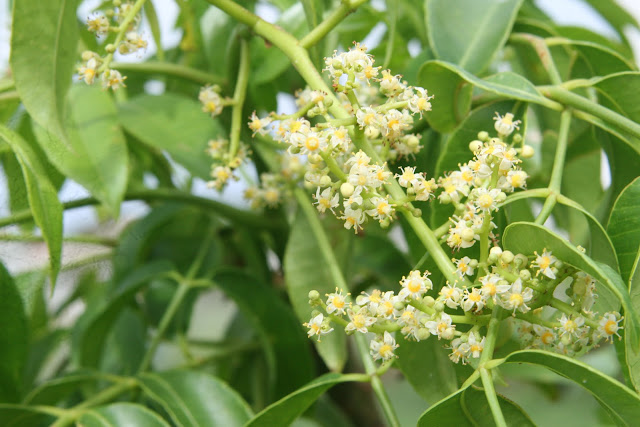 |
| Pommecythere - bunch 1 of 3 (7th May). Later image of this and other bunches below. |
Growth, Growing Medium, Adaptation to containers, Hardiness
 |
| Blossoming one-year old dwarf pommecythere tree in a wooden barrel (Summer 2012). |
I bought my dwarf pommecythere fruit tree last Summer (around July / August 2011) when it was roughly one foot tall.
After one year, it is now roughly 3 feet tall from trunk to highest tip.
Within a month or two, I transplanted my pommecythere tree into a
recycled wooden barrel. Knowing that containers are not ideal for maximum root growth, I bought high quality
organic compost,
peat moss and
manure to fill the barrel. Unfortunately, the soil has become a bit compacted with time and so it is several inches below its original level of last year. (See photo of soil level in my
October 2011 pommecythere photo). I will be refilling the container with compost very soon, time permitting.
Since the barrel is elevated, it is exposed to a lot of intense tropical heat, light and wind. The downside of this is that the metal rings that keep the barrel in tact started to fall downwards as the individual bits of wood shrunk and pulled away from each other. This experience reminded me that these barrels do not need to be 'protected' from water because they were built to hold liquids like wine and rum. To save the barrel, my pommecythere plant and soil, I had to promptly put nails below the level of the rings. Doing this has proven to be an effective way of preventing the ring from slipping any further. I also water not only the soil but also the barrel.
Another learning point has been that pommecythere plants must be very hardy to have survived the relatively dry and compact soil conditions and my neglect.
 |
| Pommecythere - bunch 2 of 3 (4th June) |
Fruiting
My dwarf pommecythere variety has attempted to fruit very quickly.
I had bought my 1-foot pommecythere fruit tree in Summer of 2011. However, by December of that year, it started to blossom when other pommecythere trees were laden with fruit. Thinking it best to allow fruit trees to fruit only after its first year, I broke off those first blossoms.
This dwarf variety appears to fruit at least twice each year. These photos are my plant's second attempt at fruiting within its first year.
 |
| Pommecythere about the size of a thumb nail - bunch 1 of 3 (4th June) |
Despite their small size, these dwarf pommecythere plants appear to fruit very abundantly. I have often observed other people's plants laden with over 30 fruits whose heavy bunches leaned over to the extent that they rested on the ground. The bunch 1 of 3 pictured on 4th June has about 13 fruits.
For those who do not know, pommecythere
fruits can be consumed either green or ripe in ways similar to mangoes.
Below my pommecythere fruit tree
I learnt the hard way that many online growing instructions for 'full sun' do not always apply to the tropics. So when I ran out of shaded spots for some extra parsley plants, I thought that the
shade of my pommecythere fruit tree would be a good place. The parsley appears to agree. Well, so far! It's been roughly 3 weeks.
I am curious to find out whether the 2 make good
garden companions for pest control, sharing nutrients and so on. However, I imagine that, apart from the benefit of shade for the parsley, the pommecythere might like the ground cover that the parsley provides. Perhaps this can slow evaporation better than the now decomposed mulch?
BTW, I backfilled the hole that I used for the parsley with homemade compost. Perhaps this is why I should not be surprised by the tiny tomato volunteer in the top part of the photo.
Other
Unfortunately, not much is online about this fruit tree. I would be happy for comments and suggestions from other organic gardeners.


